
The SAVE plan is gone: what providers need to know
The repayment plan 7 million borrowers were counting on no longer exists. Here are your real options now, and why one path still leads to tax-free forgiveness.

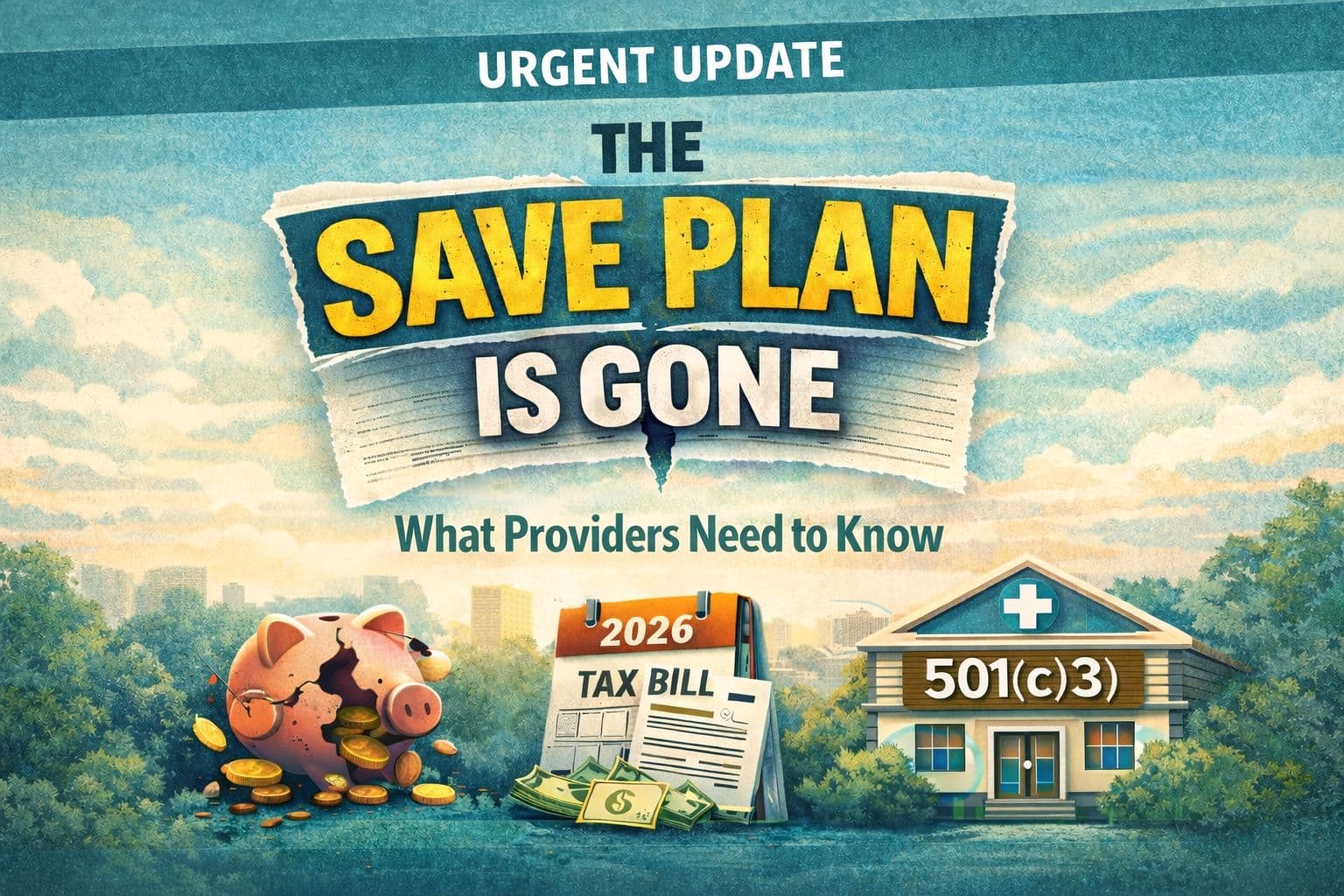
Graphic announcing the end of the SAVE student loan repayment plan with imagery representing higher payments, tax consequences, and nonprofit-based forgiveness options for healthcare providers.
I've been fielding calls and emails nonstop since the SAVE plan officially ended. Healthcare providers who had their payments paused, their interest subsidized, and their forgiveness timeline mapped out are now staring at a blank page. If that's you, take a breath. You have options. But you need to understand what actually changed before you make your next move.
Let me walk you through it.
What happened to the SAVE plan
The Saving on a Valuable Education (SAVE) plan was the most generous income-driven repayment (IDR) plan the federal government ever offered. Lower payments, interest subsidies, and a shorter forgiveness timeline for undergraduate borrowers. Over 7 million people enrolled.
Then a group of states sued, arguing the plan exceeded the Department of Education's authority. The Eighth Circuit Court of Appeals blocked SAVE in early 2025, and the "One Big Beautiful Bill" (OBBBA), signed into law on July 4, 2025, finished the job. SAVE is being phased out completely by 2028, and no new enrollments are allowed.
Tax-free forgiveness is still on the table
Watch our free training to learn how healthcare providers are qualifying for PSLF through their own nonprofits.
If you were on SAVE, your loans went into a holding pattern. Interest started accruing again in August 2025. The Department of Education sent emails encouraging borrowers to pick a new plan. Many people I talk to say they got those emails and had no idea what to do.
That's fair. The options are confusing.
Your repayment options right now
Here's where things stand for federal student loan borrowers as of early 2026.
Income-Based Repayment (IBR)
IBR is still available. If you borrowed before July 2014, payments are capped at 15% of discretionary income with forgiveness after 25 years. If you borrowed after July 2014, it's 10% with forgiveness after 20 years.
The catch: IBR uses a lower income threshold than SAVE did, which means higher payments for most borrowers. And the forgiveness timeline is long. We're talking two decades or more of payments before you see any relief.
The Repayment Assistance Plan (RAP)
RAP is the new plan created by Congress to replace SAVE. It launches July 1, 2026. Here are the basics:
- Payments start at $10 per month if your adjusted gross income (AGI) is under $10,000
- Payments scale up gradually, capping at 10% of AGI for incomes above $100,000
- Any unpaid interest is canceled each month (your balance won't grow if you're making your required payment)
- Forgiveness comes after 30 years of qualifying payments
RAP is simpler than the old system, and the interest cancellation feature is genuinely helpful. But 30 years is a long time. For a chiropractor or naturopathic doctor who graduated at 28, that means forgiveness at 58. At the earliest.
Standard repayment
You can always switch to the standard 10-year repayment plan. Fixed payments, no forgiveness, but you're done in a decade. For borrowers with smaller balances, this sometimes makes sense. For most healthcare providers carrying $150K or more, the monthly payments are brutal.
The tax bomb nobody's talking about
Here's the part that caught a lot of people off guard.
The American Rescue Plan Act made IDR forgiveness tax-free starting in 2021. That provision expired on December 31, 2025. As of January 1, 2026, any student loan forgiveness through IDR plans (IBR, PAYE, RAP, or whatever comes next) is treated as taxable income.
Let me put that in concrete terms. If you've been on IBR for 20 years and your remaining balance of $200,000 gets forgiven, the IRS treats that $200,000 as income for that tax year. Depending on your bracket, you could owe $40,000 to $60,000 in federal taxes. In a single year.
This isn't hypothetical. It's the law right now. And it disproportionately affects healthcare providers with high debt balances who've been making income-driven payments for years.
There is one major exception to this rule.
PSLF remains tax-free
Public Service Loan Forgiveness (PSLF) has always been tax-free. That hasn't changed. And unlike IDR forgiveness at 20 to 30 years, PSLF forgiveness happens after just 120 qualifying monthly payments. That's ten years.
Let me repeat that because it matters: PSLF is tax-free, and it's ten years. Not 20. Not 25. Not 30. Ten.
The requirements are straightforward:
- Direct Loans (or consolidate into Direct Loans)
- A qualifying repayment plan (any IDR plan counts, including RAP when it launches)
- Full-time employment with a qualifying employer (30+ hours per week)
- 120 qualifying monthly payments (they don't have to be consecutive)
The piece that trips up most healthcare providers is the employer requirement. PSLF qualifying employers include government agencies, 501(c)(3) nonprofit organizations, and certain other nonprofits that provide qualifying public services.
If you're in private practice, your employer doesn't qualify. If you work for a for-profit hospital or clinic, your employer doesn't qualify.
But here's what most people miss.
You can create your own qualifying employer
PSLF doesn't care about your specialty. It doesn't care whether you're a chiropractor, a naturopathic doctor, an acupuncturist, or a dentist. It cares about one thing: your employer's tax status.
A 501(c)(3) nonprofit organization is a qualifying PSLF employer. Period. And you can launch one yourself.
This surprises most people. They assume PSLF means working at a hospital or a government clinic. But the law is clear: any 501(c)(3) organization counts. Including one you found and operate to serve your community.
I did exactly this in 2014. I was a chiropractor in private practice with over $150,000 in student debt. No hospital was going to hire me. No government agency was offering me a position. So I created a nonprofit to provide chiropractic care to underserved patients in my community, and I employed myself through it.
The nonprofit wasn't a paperwork exercise. I served veterans, first responders, and families who had been living with pain because they couldn't afford care. Those patients needed someone, and providing care for them qualified me for PSLF at the same time.
Ten years later, in 2021, I received tax-free forgiveness through PSLF.
The dual-entity model
The question I get most often: "Do I have to give up my private practice?"
No. Absolutely not.
The model that works for our clients (and the one I used personally) is a dual-entity structure. You keep your private practice running as it always has. Separately, you launch a 501(c)(3) nonprofit that serves patients who can't afford care, or who are underserved in your community.
You employ yourself through the nonprofit for at least 30 hours per week. The nonprofit pays you a reasonable salary. That salary counts as qualifying PSLF employment.
Your private practice continues to generate revenue. Your nonprofit expands access to care. And your student loan payments count toward the 120 you need for PSLF.
It's not a loophole. It's how the program is designed to work. Nonprofits that expand healthcare access are exactly the kind of public service PSLF was created to incentivize.
Why this matters more now than ever
Before the SAVE plan ended, healthcare providers with high debt had a viable (if slow) path to forgiveness through IDR. Payments were manageable. Interest was subsidized. The timeline was long, but the destination was clear.
That path has fundamentally changed. RAP extends forgiveness to 30 years. IDR forgiveness is now taxable. And for providers earning $100,000 or more, monthly payments under RAP may be just as painful as they were before SAVE existed.
PSLF is now the only federal loan forgiveness program that offers all three of these features:
- Tax-free forgiveness (no surprise tax bill at the end)
- 10-year timeline (not 20, 25, or 30)
- Available to any specialty (through 501(c)(3) employment)
For healthcare providers, the math has never been more clear. And the nonprofit pathway to PSLF has never been more relevant.
Who this works for
I've worked with chiropractors, naturopathic doctors, acupuncturists, dentists, physical therapists, nurse practitioners, and more. The nonprofit pathway works across specialties because PSLF eligibility is tied to employer type, not provider type.
Most of our clients are in one of three situations:
- Private practice owners carrying $150K to $400K in debt, often 5 to 20 years into their careers
- Early-career providers with $200K+ in debt and payments that consume a painful chunk of their income
- Alternative and holistic practitioners who are already providing informal charity care but not getting any credit for it
If any of that sounds familiar, this pathway is worth a serious look.
What you should do right now
If you're a healthcare provider with federal student loans, here's my honest advice:
Step one: Check your loan type. Make sure you have Direct Loans or consolidate into the Direct Loan program. Only Direct Loans qualify for PSLF.
Step two: Get on an IDR plan. Even if RAP isn't available until July, enroll in IBR now. Your payments will count toward PSLF as long as you have qualifying employment.
Step three: Evaluate the nonprofit pathway. If you're in private practice (or even employed at a for-profit clinic), you can create a 501(c)(3) nonprofit that qualifies as a PSLF-eligible employer. This is the step most providers don't know about.
Step four: Stop waiting. Every month you delay is a month that doesn't count toward your 120 qualifying payments. I've worked with providers who spent years "thinking about it" before starting. They all say the same thing: "I wish I'd started sooner."
The bottom line
The SAVE plan is gone. The student loan landscape in 2026 looks different than it did even 12 months ago. Payments are higher, timelines are longer, and forgiveness through IDR is now taxable.
But PSLF hasn't changed. It's still ten years. It's still tax-free. And through the nonprofit pathway, it's available to healthcare providers in any specialty.
I've helped over 600 healthcare professionals launch nonprofits and qualify for PSLF. I completed the process myself. It works. And if you're sitting on six figures of student debt wondering what to do next, this is the path worth exploring.
Ready to explore the nonprofit PSLF pathway?
Join 600+ healthcare professionals who have launched nonprofits and qualified for tax-free Public Service Loan Forgiveness. Our free training walks you through the entire process.